

Object Number: #512
Marks: Hannover 1740
Maker: Johann Jobst Soehlcke (Senior)
City hallmark: Cloverleaf with the finesse number “12” for the year ca. 1743 (Scheffler 1965, no 1380)
Maker’s mark: “JB” in a curved shield for Johann Jobst Soehlcke (Senior) (1700-1771) (Scheffler 1965, no 1382)
Pictures
Detailed Information
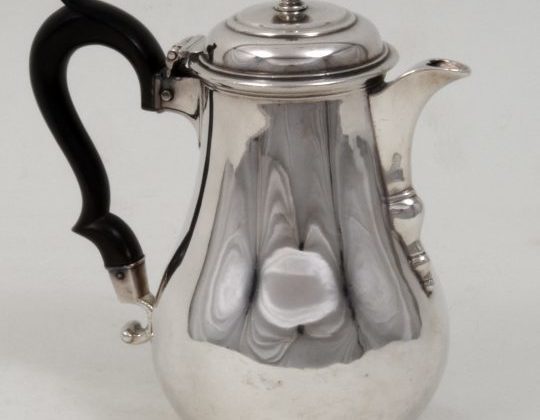
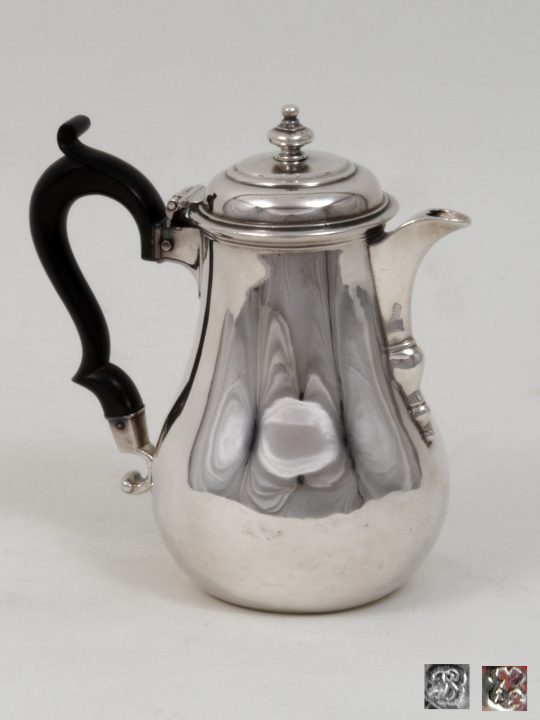
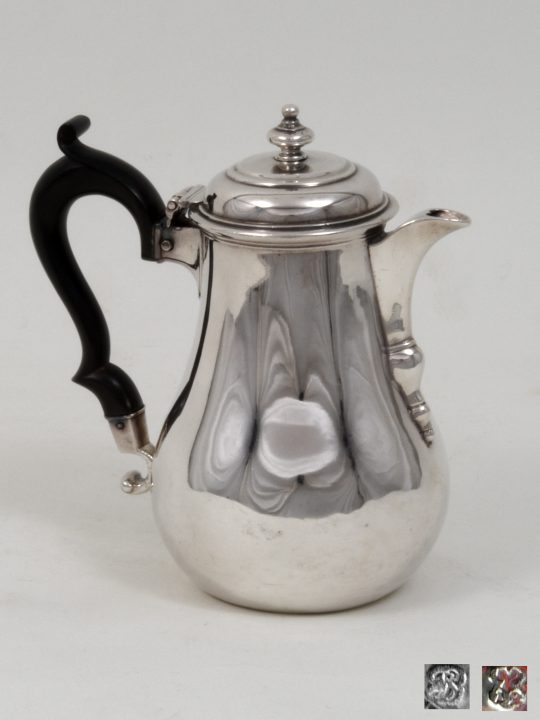
The present coffeepot is an object from Hanover. Very typical for this object is the fact that it has a simple form, with no foot. The bulging, pear-shaped body has no decorative elements and its walls are slick. The spout is cast and decorated on its lower part with two knobs. The round, slightly vaulted, hinged lid is profiled with two rings and has a cast, round-form finial. The loop-handle is raised on the side and it has a thumb rest.
Drinking tea was established in Europe around the last quarter of the 17th century. During this time, tea, exactly like coffee and cacao, was almost exclusively prescribed from doctors and was sold in pharmacies. However, these three new warm beverages had conquered the continent by the beginning of the 18th century, through the princely courts and the bourgeoisie. Many new silver objects were developed around these three hot beverages.
In the history of silver- and goldsmith in Hanover, goldsmiths can be documented as early as 1310. With the implementation of the freedom of arts and crafts that was in force in Prussia, the office of goldsmiths was dissolved in Hanover in 1868.
Since the second half of 17th century, the ceremonies of the court as well as the production of silver- and goldsmith objects were oriented to French models.
Maker: Johann Jobst Soehlcke (Senior) originated from Hammeln and was born around 1700. He paid the citizenship’s income on 1736 and on the same year, he got married to Sophie Magdalena Jünger. He is later, in 1768 mentioned as a maker. He died in 1771.
His son Johann Jacob Soehlcke (Jun.) is also mentioned as a goldsmith (Scheffler 1965, Nr. 1382, SN 42, S. 731).
A coffeepot from Johann Jobst Soehlcke with a similar form as well as similarities in the execution and in the handle is in the Historical Museum of Hannover (VM 17767; cf. Von Rohr 1993: fig. on the p. 35).
Literature:
Scheffler, W., 1965, Goldschmiede Niedersachsens: Daten – Werke – Zeichen, 2. Halbband, Hameln-Zellerfeld, Berlin: De Gruyter
Von Rohr, Al., 1993, Edles Tafelgerät: Silber aus dem Historischen Museum Hannover, Historisches Museum Hannover