

Object Number: #723
Aurich, ca. 1785-1800
Maker: Wilhelm Friedrich Kittel
Town hallmark: in a shield, a Latin letter “A” with three points above, which remind of a crown, for Aurich (East Frisia) (Scheffler no 17; Tardy 1987: 33).
Maker’s mark: mark, or rather the monogram „K“, in a shield probably for Wilhelm Friedrich Kittel (Scheffler no 23) or Carl Fridrich Kittel (Scheffler no 26a; MZ no 24).
Other marks: a crowned “O”. In 1800 came into force the punching for the Batavian Republic (1795-1806). The Batavian Republic was transformed to the Kingdom of Holland (1806-1810) in 1806. In 1807 was introduced the punching of objects. Here belongs also the often met mark of a crowned O, destined for older pieces. It is thus a punch of re-examination (Rosenberg3 no 7541).
A crown with “ET”. It is here also a French punch of re-examination or an import mark. Between 1809 and 1819 different marks were introduced in France and the conquered countries. Among them one finds also a punch for foreign objects, namely a crown for bigger objects and the letters “ET” (= étranger, foreign in French) (Tardy 1987: 424). The Netherlands was under French occupation since 1795.
Dimensions: Height: 20 cm (7.9 in); Weight: each 340 gr.
Pictures
Detailed Information
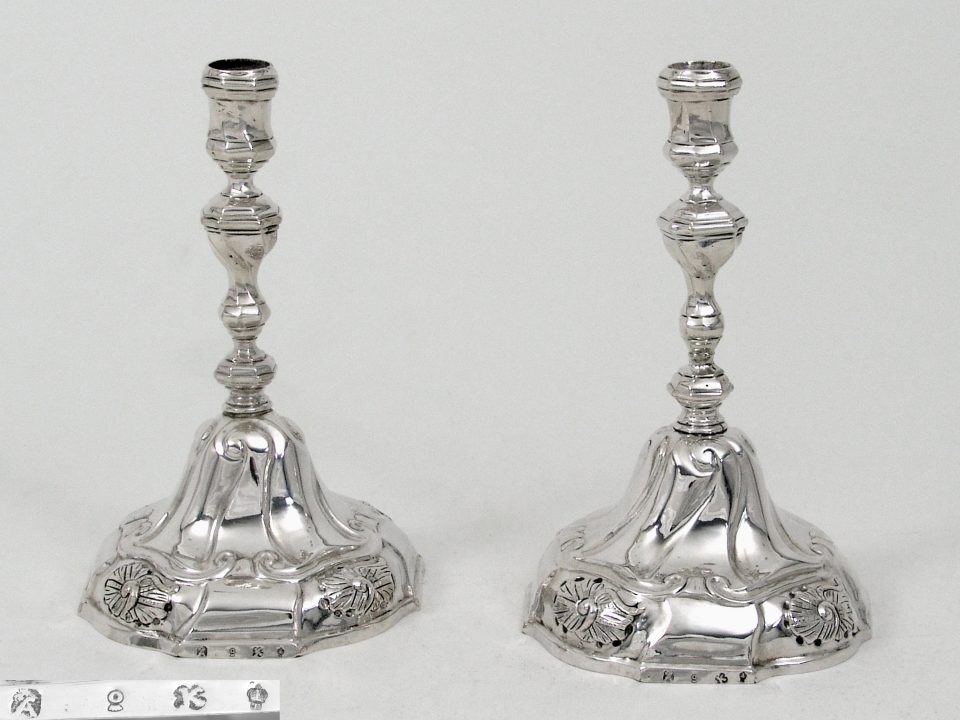
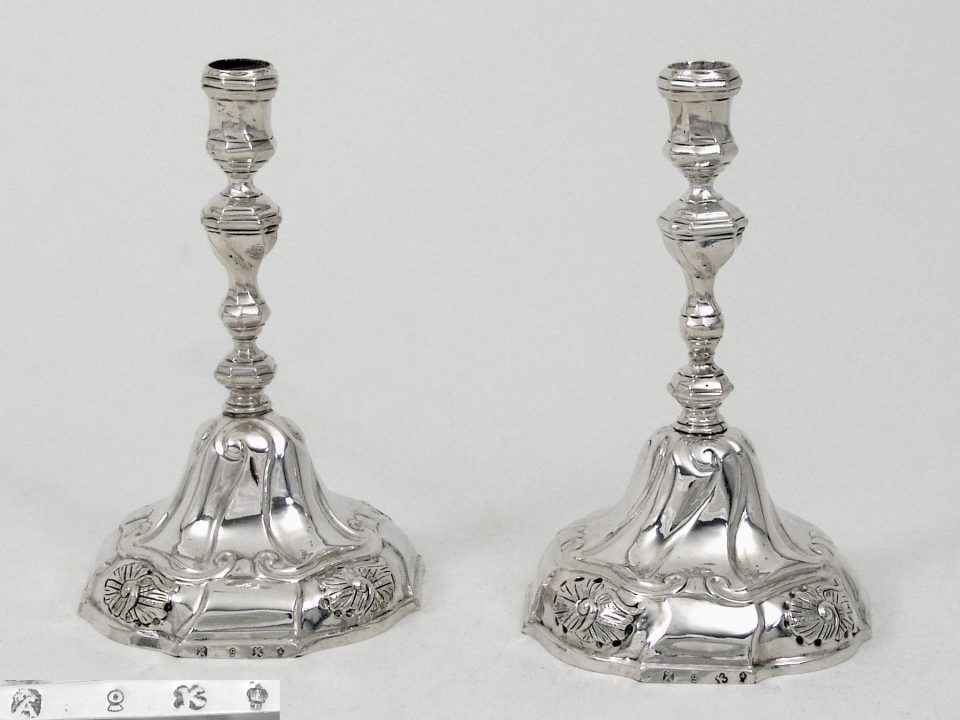
This pair of candlesticks presents an interesting Rococo example from Aurich, East Frisia. The foot has a wide, bell-shape and is profiled through eight edges. Rich moulded and chased work with naturalistic motifs as well as curved decors adorn the foot. While the bell-shaped part of the foot presents a rich decoration in twisted lines, the shaft is strictly horizontal structured. Twisted lines and balusters are its main décor. The ornamental choice of twisted lines continues also to the spout. The overall impression given is that of a movement, which has an impressive effect.
The silversmith from the North of Germany presents a large history since the 15th century. Especially between 1790 and 1870 silversmiths could settle there without any serious difficulties.
When East Frisia became a province of Prussia, the new administration tried to organise the arts and crafts. After 1744 and intensified since 1767 the war and domain Chamber in Aurich was pushing either for the creation of a guild or for the connection to the guild of Emden. However, the gold- and silversmiths were resisting to that. They referred to old rights of Friesland and to the good reputation of the city for the art of silversmith. Despite this, the Prussian Chamber was trying to reach generally equal conditions and therefore strived for the establishment of a guild. The makers however did not join together to a guild.
Among the smiths of noble medals from East Frisia were important makers, who could master the demanding techniques of gold- and silversmith and could present very well executed works.
However, between 1650 and 1870 smiths of noble medals from the North of Germany were working unequally more with silver than with gold and some of them, who had the professional title of “goldsmith”, were indeed exclusively silversmiths.
Maker: Probably Wilhel Friedrich Kittel (Scheffler no 23), born on the 30th Januray 1738, as son of Johann Christian Kittel from Pirna, a footman of Karl Edzard, Prince of East Frisia, and latter of the princess Frederica (Kittel 1938: 9-10). He was in Aurich since 1761. He got married for the first time in 1770 to Anna Elisabeth Timmermann and for the second time in 1773 to Christiane Antoinette Brandes. He died on the 12th April 1803.
Or his son
Carl Fridrich Kittel (Scheffler no 26a), born on the 13 December 1771 as son of Wilhelm Friedrich and his first wife. He got married as a gold- and silversmith in Aurich to Catharina Elisabeth Escherhausen, daughter of a priest from Stedesdorf (Emden).
A Christian Adolf Kittel (b. 1786), also son of Wilhelm Kittel, appears to have worked also as a silversmith. However, it is presumed that his works come finally from Carl Fridrich Kittel (Scheffler no 30).
The Kittels were an important family established in Northern Germany. Some of the family-members were known silversmiths. Even if it cannot always be assured, if it is the work of the father or of the son, many silver pieces indicate a very well executed work.
Literature:
Kittel, G., 1938, Ostfriesische Charakterköpfe. Bilder aus der Kittelschen Sippe in Ostfriesland nebst ihrem Stammbaum, Celle: Verlag von Schweiger & Pick
Scheffler, W., 1965, Goldschmiede Niedersachsens: Daten – Werke – Zeichen, I. Halbband, Aerzen-Hamburg, Berlin: De Gruyter
Norder Silber aus Kirchen, Museen und Privatbesitz, Kat. Ausst. 16. Mai bis 29. Juni 1997, Der Heimatverein Norderland e.V.
Rosenberg, M., 1928, Der Goldschmiede Merkzeichen, Dritte erweiterte und illustrierte Auflage, IV. Band Ausland und Byzanz, Berlin: Frankfurter Verlags-Anstalt [Rosenberg3]
Tardy, 1987, Les poinçons de garantie internationaux pour l’argent, suivi d’une étude de W. Van Dievoet sur les poinçons européens de la Révolution et de l’Empire, Paris: Tardy