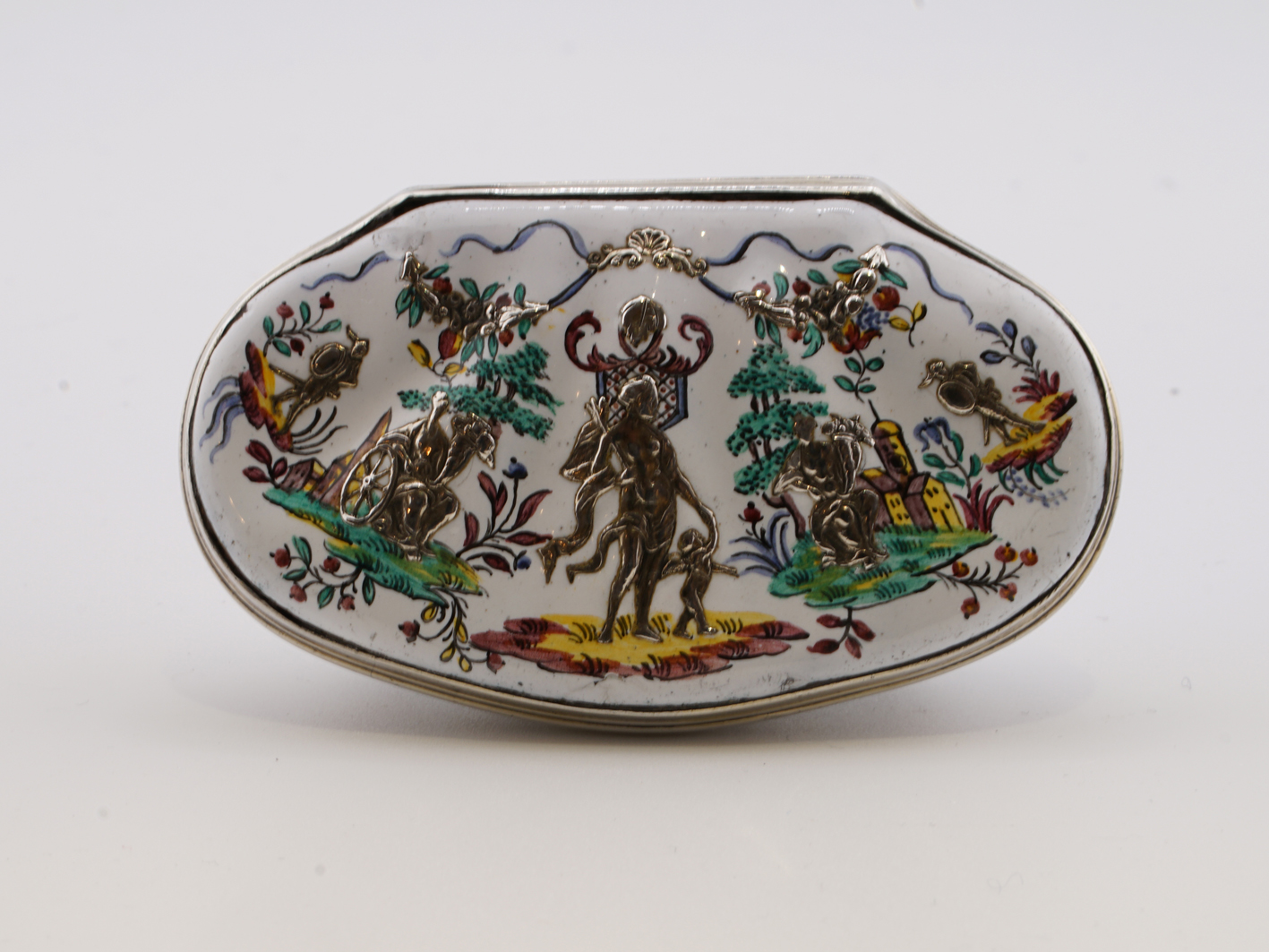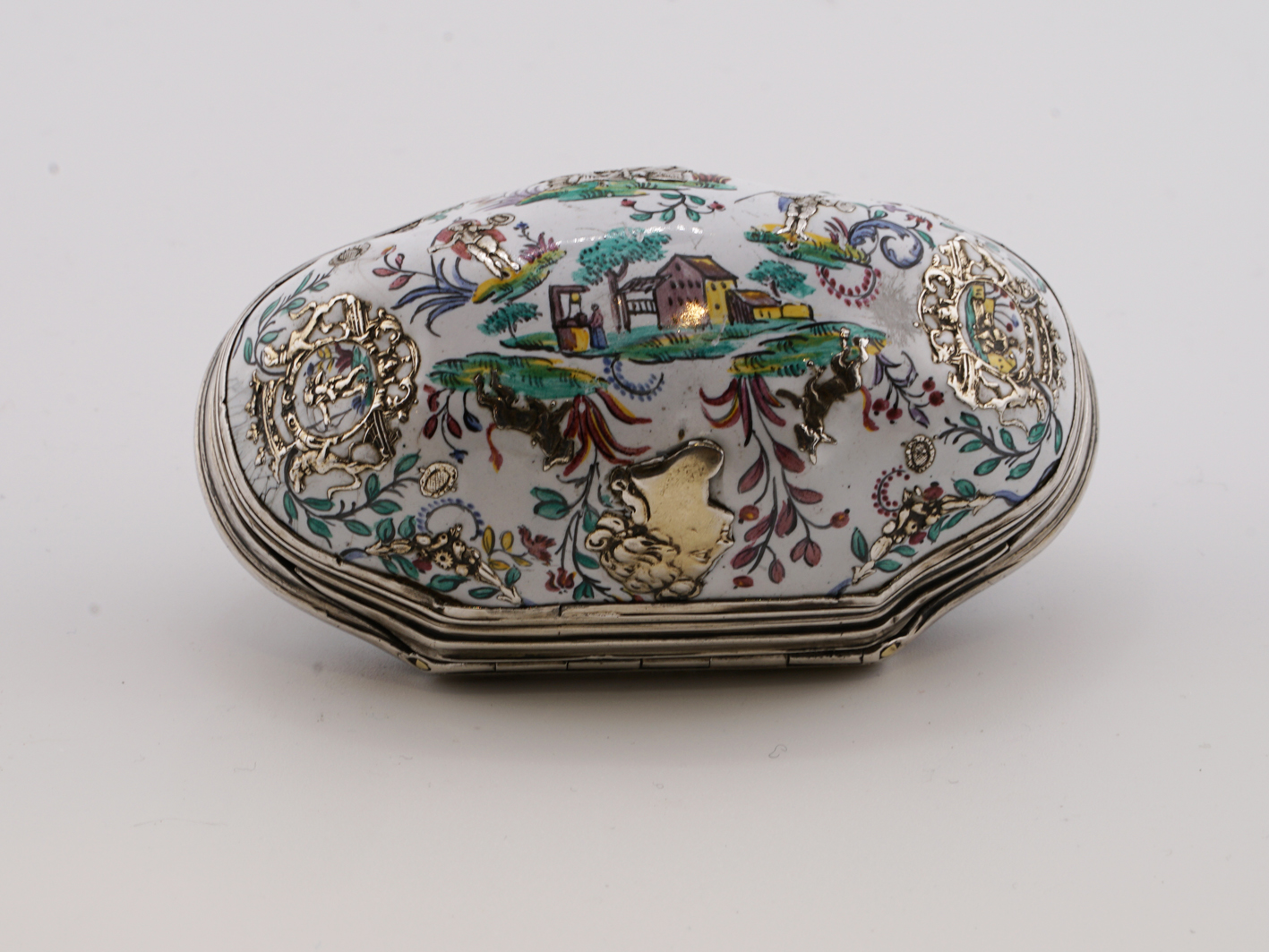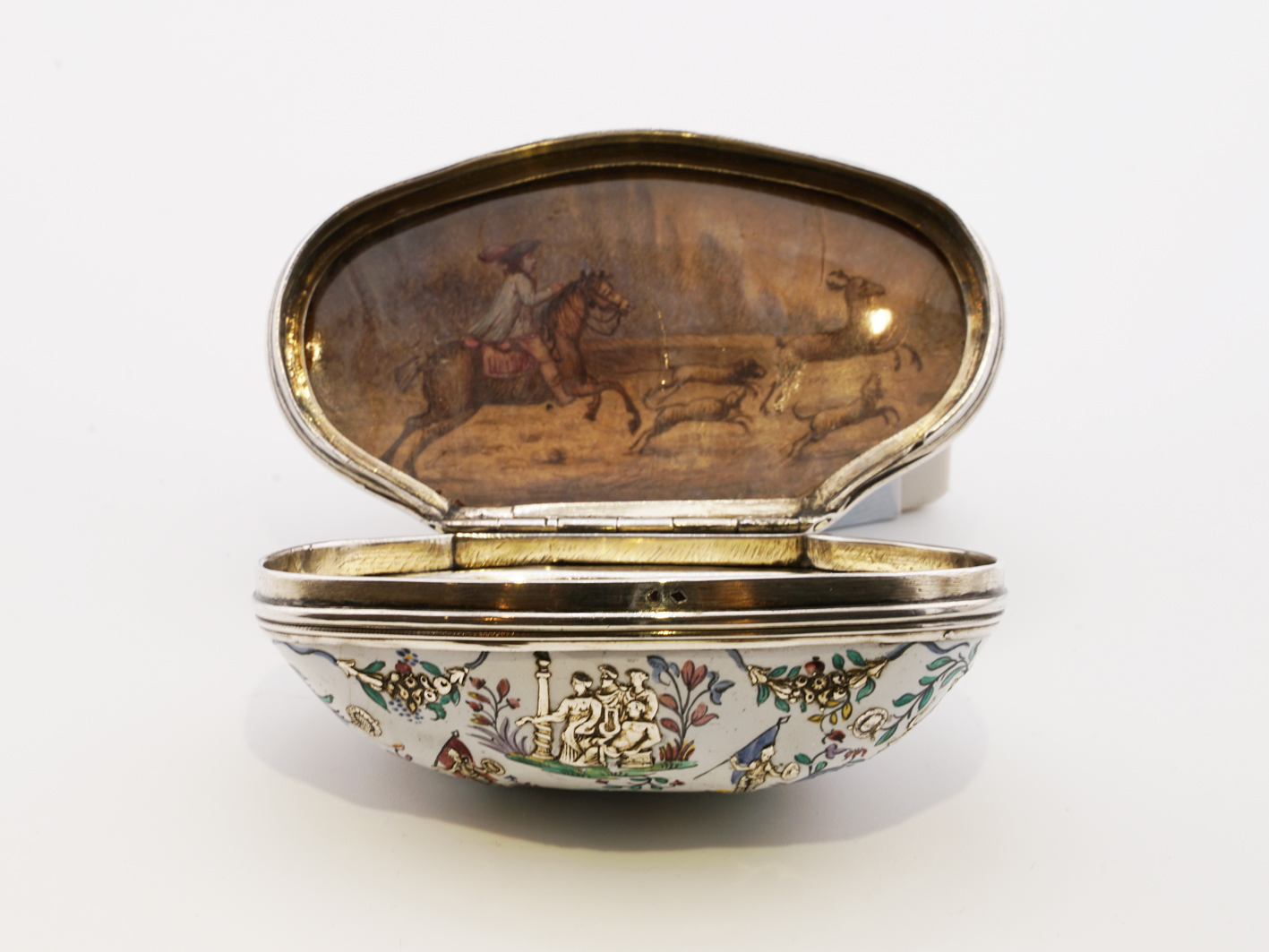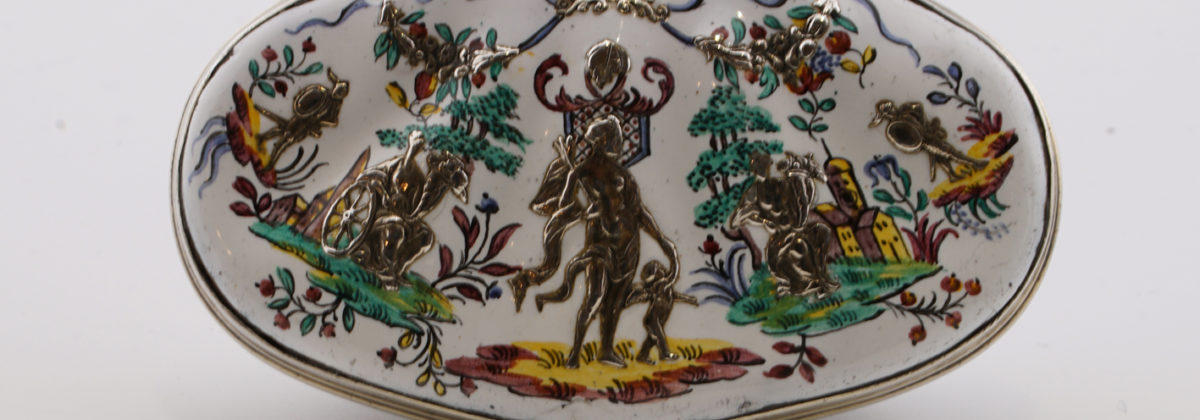
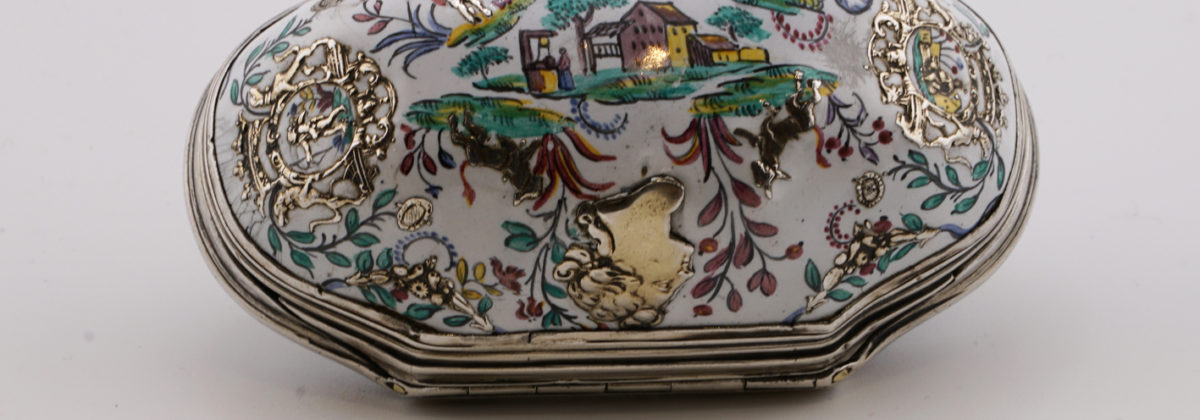
Outstanding Fromerie box, Berlin, around 1760
Masterfully crafted with inlaid silver decorations
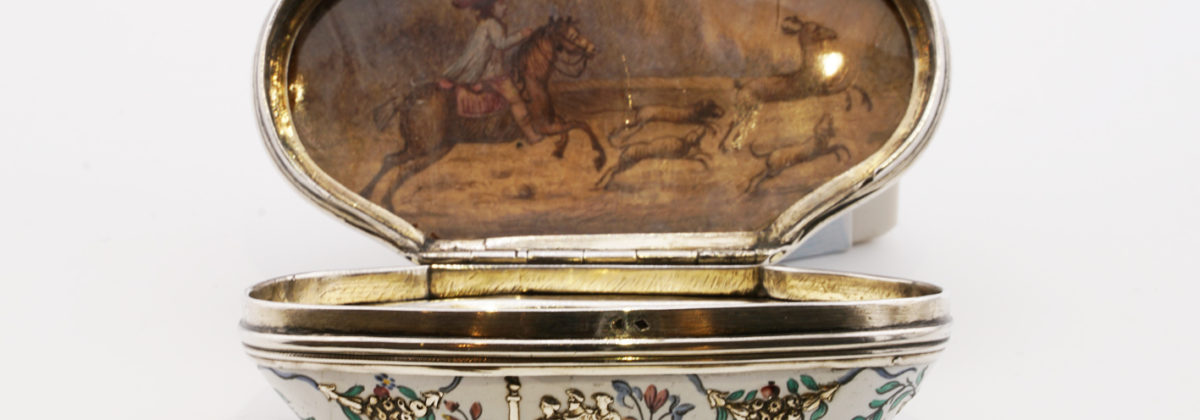
Gilded inside; inside the lid, a hunting scene
Luxury Enamel Goods
Toilet sets and/or boxes produced with white enamel are referred to as “email de Saxe”. Their chief feature is the colourful paintings on thewhite enamel surface. This technique was mostly used in Dresden by Dinglinger, in Berlin by the workshop of Fromery and in Augsburg.
In the early eighteenth century, French snuff boxes (tabatières) made of gold and enamel or of other precious materials, were increasingly fashionable in Germany. These were mostly used for the storage of snuff tobacco, but also for powder, pills and bonbons.
The ascent to power of Frederick the Great (1712-86) resulted in a restriction on the importation of such “boxes” from France. The goal was to encourage the local production of such wares. Frederick was a great collector and user of such snuff boxes, just as Heinrich von Brühl (1700-63), the head of the Meissen Porcelain Manufactory.
The Production of such boxes with luxurious floral motives became a popular and common practice throughout upper-class Europe. The inclusion of detailed religious motives, in the present box, gives it a certain degree of significance and intrigue, beyond simply decorative florals. Great examples of comparable works using similar techniques during the same period can be found in the collection of the MAK – Austrian Museum for applied art: https://sammlung.mak.at/sammlung_online?&q=email%20dose .
Pictures